
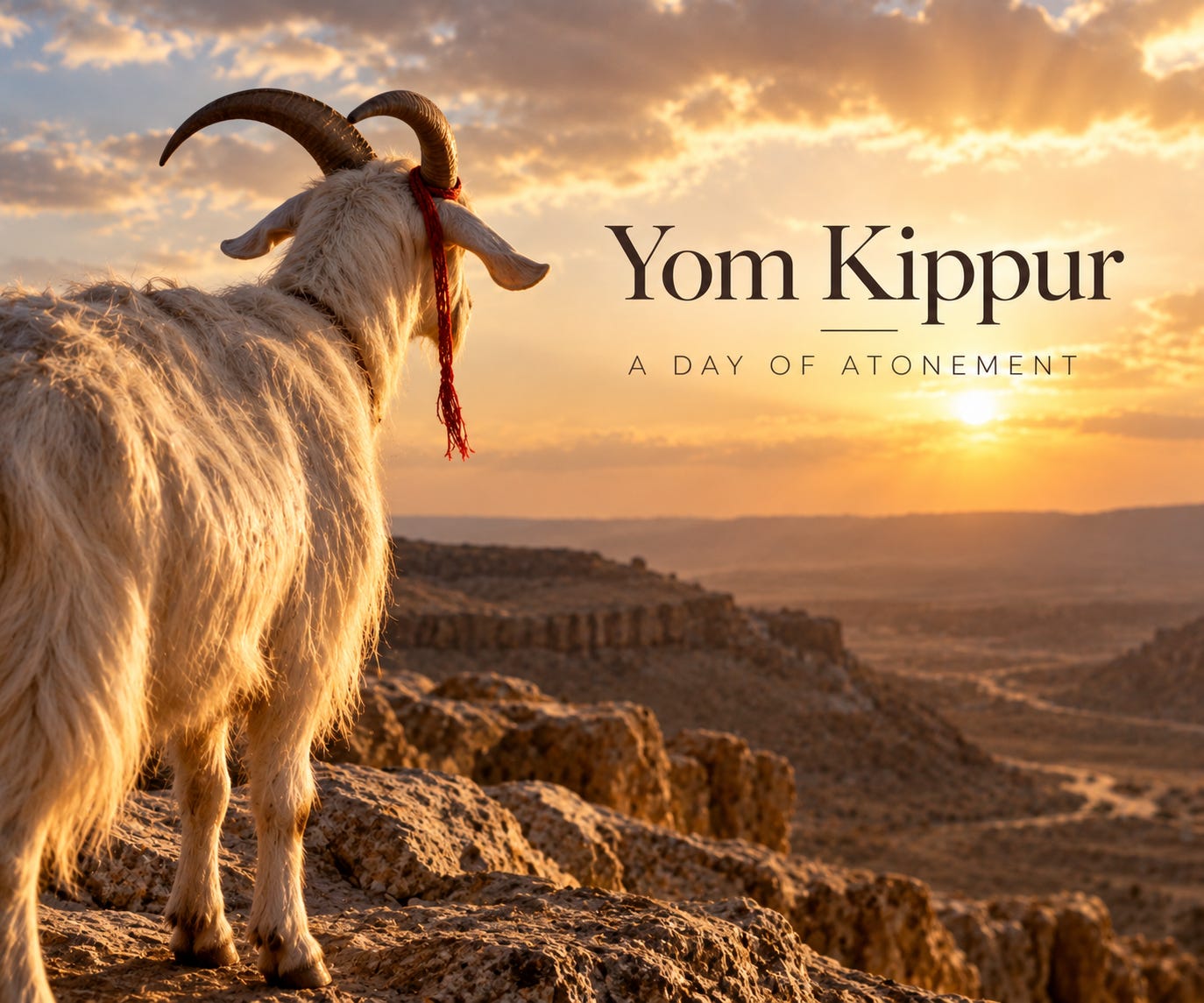
I love goats. I think they are the greatest of all time. And I’m so happy we no longer push them down cliffs, as we used to do back when the crimson thread turned white.
Oh, you have no idea what I’m talking about? Well, buckle up, because Yom Kippur, the Day of Atonement, is upon us again. On this day, we are fasting for 24 hours, remembering our sins and asking God and people for forgiveness. It is commanded in Leviticus 23:26-32. This is the one day a year when God atones for everyone’s sins.
Or is it?
You may say that Yeshua did this once and for all on the cross, and you’d be right. You may say that this holiday is irrelevant in the era of the New Covenant, and you’d have a point. My counterpoint would be Paul the Apostle. “Examine yourselves to see whether you are in the faith.” 2 Corinthians 13:5. Why not have a time once a year to fast and do only that? And why not use the specific time God has already appointed for it? More on that later.
The specific instructions about this day are in Leviticus 16. It’s the one time a year when the High Priest went into the Holy of Holiest. There was an elaborate system of sacrifices and rituals to be performed in the correct manner, and one of those rituals described in the Torah included bringing two goats and casting lots between them. One was “for the Lord” and the other was “for Azazel.” In English, known as the scapegoat.
(Nerdy sidetrack footnote for people who want to fall down this Azazel rabbit hole with me – There are various ideas about what Azazel means, whether an evil desert spirit, a fallen angel mentioned in the book of Enoch, a nickname for Satan, or maybe it comes from “ez-azal,” “goat of the rule” in Aramaic. Or maybe just “ez-El” – goat of God. Some say that it was named after two Nephilim named Uza and Azal, from the time of the flood. In the old Greek translation, the Septuagint, it says “the goat of departure,” and in the English translations, this goat was called “the scapegoat,” based on the Greek interpretation and an old English word for escape or departure. End of nerdy footnote).
They sacrificed the goat that got the lot “for God,” while the sins of the people were symbolically put on the scapegoat, and then they sent it out into the wilderness (verse 10).
What the Bible doesn’t tell you is that there was a crimson-red thread they used to tie around the horn of the scapegoat. And if God forgave the sins of the people, it turned white through a miracle, based on Isaiah 1:18, “Though your sins are like scarlet, they shall be white as snow. Though they are red as crimson, they shall be like wool.” This crimson thread was called “Leshon haZehorit.”
If it’s not in the Bible, how do we know about it? Because we can read about it in the Mishna, which is the earliest part of the Talmud. It was written down in the 200s AD, but preserves traditions about the Temple rituals from before its destruction, so this tradition may well reflect practices remembered from the Second Temple period.
Now, they didn’t actually send out the scapegoat to wander around and starve in the wilderness, because then it would walk into inhabited areas and bring the sin back in. No, they had a system where someone would accompany the goat into the desert east of Jerusalem, passing stations of food and sleep along the way, until they reached Mount Montar, about 9 miles away, where the man accompanying the goat pushed it off the cliff. One source says they tied the crimson thread around its horn in the temple, and before the goat was pushed down the cliff, the person who brought it cut off half of the thread and tied it to the rock. Then, after it was pushed down, the thread became white. Another source says they let the thread hang in the temple, and there they would see if it became white.
If the thread stayed red, it was a bad omen. It meant that God didn’t forgive the people’s sins for whatever reason.
Now get this—one source in the Talmud says that “for forty years before the destruction of the Temple the thread didn’t become white.”
Did you catch that? Again, the Talmud explicitly says that “for forty years before the destruction of the temple the thread didn’t become white.” Not even once! What happened exactly forty years before 70 AD? You see where I am getting with this?
Yes, it actually says that, and yes, you can still look it up in Jewish sources. It’s in a Baraita (an ancient legend that has survived because it is quoted in a later part of the Talmud) that is quoted in the Babylonian Talmud, Tractate Yoma, chapter 4, daf 39, part B. Know what? Just for the sake of believability, here are the exact wording and links to the sources:
ארבעים שנה קודם חורבן הבית לא היה גורל עולה בימין ולא היה לשון של זהורית מלבין ולא היה נר מערבי דולק והיו דלתות ההיכל נפתחות מאליהן
“Our Rabbis taught: During the last forty years before the destruction of the Temple the lot [‘For the Lord’] did not come up in the right hand; nor did the crimson-coloured strap become white; nor did the westernmost light shine; and the doors of the Hekal would open by themselves.”
The Wikisource link of that specific chapter in the Talmud in Hebrew: https://he.wikisource.org/wiki/%D7%99%D7%95%D7%9E%D7%90_%D7%9C%D7%98_%D7%91
For English, the best we can do is a pdf for the entire Yoma tractate of over 400 pages. The relevant part is daf 39b which is at the bottom of page 115. https://halakhah.com/pdf/moed/Yoma.pdf
What do the Rabbis answer when asked about this? Well, they say that we are being selective in choosing which parts of the Talmud we believe in, and that correlation doesn’t imply causation. Fair points, but I still think this is a really strong case. IF Yeshua indeed was the ultimate sacrifice, it makes perfect sense that God would stop accepting the Yom Kippur sacrifices after that. It also makes no sense that the Rabbis would make up a story like that, strengthening our position, unless it was true.
Many Christians will say that Yom Kippur is now irrelevant. Our sins are already atoned. We have forgiveness of sins 24/7. We can turn to God and repent of our sins whenever we want, not just on Yom Kippur. They do have a strong case, especially when we read what the New Testament says about Yom Kippur:
“But only the High Priest entered the inner room, and that only once a year … this is an illustration for the present time … external regulations applying until the time of a new order.”
Hebrews 9:7,9,10 NIV
But should we really cease observing Yom Kippur altogether? I can’t see any scripture that supports a full cessation of keeping the holy days God gave us. I do think that there is a point in keeping it.
I have heard some Messianic Jews who solve this question by saying that this is a good holiday to celebrate our atonement. Rather than praying and crying over our sins, like the orthodox Jews do, we can celebrate that our sins have already been forgiven.
With all due respect, I think that celebrating Jesus death on the cross is what we do on Pesach, not on Yom Kippur. Yom Kippur was never intended to be a celebration. It’s a day of fasting, of self-reflection and of repenting our sins.
And I think that this is where we find the true meaning of Yom Kippur for the Messianic Jew today. It is not a day to ask God to forgive our sins, nor is it a day to celebrate the forgiveness we have. But it is a day to repent. To take one day a year of fasting, praying, repenting and take stock of our life. Ask ourselves where we are on our walk with God and where we want to be. How can we do better next year? Where do we wish our spiritual life to be next Yom Kippur?
Yes, Yeshua gave us eternal forgiveness. Yes, our sins are forgiven. But we are still required to confess our sins. To bring them before God. We can do this daily if we wish, but having one day a year that is intended to fast and pray over it is essential. It gives us a yearly opportunity to do what Shaul told the Corinthians: “Examine yourselves to see whether you are in the faith; test yourselves.” 2Cor 13:5 NIV
For us, therefore, Yom Kippur is no longer a time to push goats down a cliff, no matter how fun it sounds. Instead, we can hug our goats, as I always want to do. For us, it is time to remember that Jesus is our scapegoat. He took our sins upon himself and went willingly to the cliff (or the cross) to eradicate our sins once and for all. Our thread remains white for all eternity and never becomes red again.
For us Israelis, Yom Kippur also carries a more recent memory. In 1973, Egypt and Syria launched their surprise attack on this day, while the country was fasting and much of Israel had shut down. The Yom Kippur War permanently attached another layer of national memory to an already solemn day. Tragically, fifty years later, another of these fall holidays would acquire its own memory of a surprise attack. I’ll get to that later in this series.
But neither war has changed what Yom Kippur itself feels like. For me, Yom Kippur is the one day a year when I disconnect from the life circus. In our family, we shut off all phones and electronics (except one for emergencies), not because we believe we have to, but because it puts us in “Yom Kippur mode.” When we don’t need to spend any time cooking, eating, or washing dishes, when we are not distracted by our phones, we can use the time to read scriptures, reflect, repent from our sins. It’s a yearly reminder to follow Him daily. We are already justified through the blood of Yeshua. Our names are already in the Book of Life. Yom Kippur is when we work on our sanctification and get closer to God.
I pray that your personal sanctification thread becomes whiter and whiter with every year. Don’t do like the temple priests and don’t let forty years go by with a crimson thread that never changes. Your sins were all put on the one and only ultimate scapegoat and pushed down the cliff. Act like it.
Baah!
===========
If you enjoy these reflections and want to support my writing, you can:
Support my work monthly on Patreon
Send a one-time gift via PayPal
Thank you for helping me keep writing from Jerusalem.
"Though your sins are like scarlet, they shall be white as snow."
Amen.
That is really something about the thread not turning white. I wonder how many secretly believe it is because of Jesus. I have heard there are believers even among the Orthodox.